
Thermostat Recovery Mode Explained: Is It Wasting Your Savings?
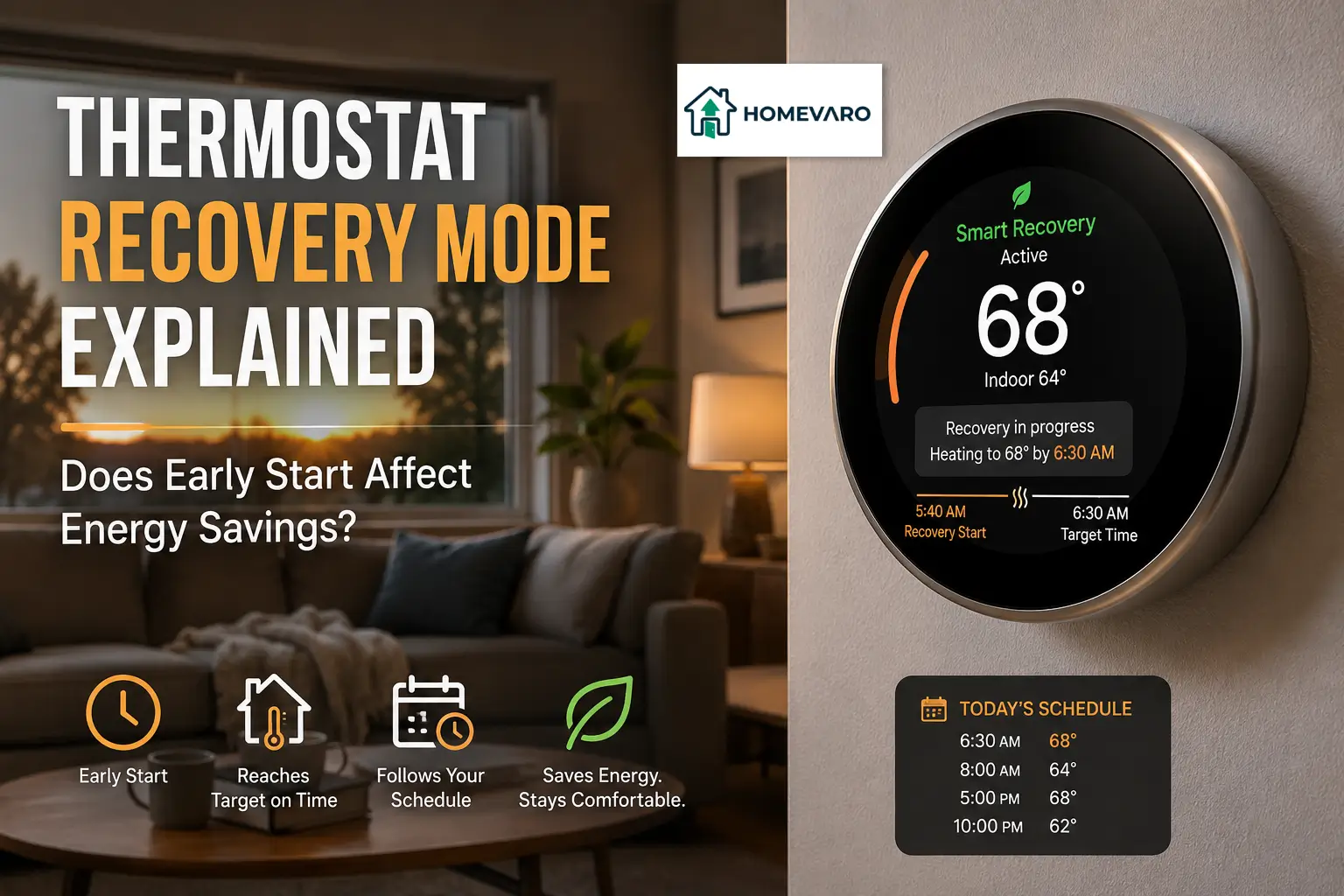
Your thermostat is set to reach 68 degrees by 6:30 a.m., but the furnace or heat pump kicks on at 5:40 a.m. instead. Nobody touched the schedule. The screen just says “Recovery.” That is not a glitch, and it is not the system ignoring your setback. It is the one feature that decides whether your setback actually gets used every day or gets switched off out of frustration within a month.
What “recovery” actually means on your thermostat’s screen
Recovery mode, also called adaptive recovery, smart recovery, or early start depending on the brand, is the thermostat working backward from your schedule instead of forward from the clock. A plain schedule starts heating or cooling at the time you set. Recovery starts before that time, calculated so the house arrives at your target temperature by the moment you actually asked for it.
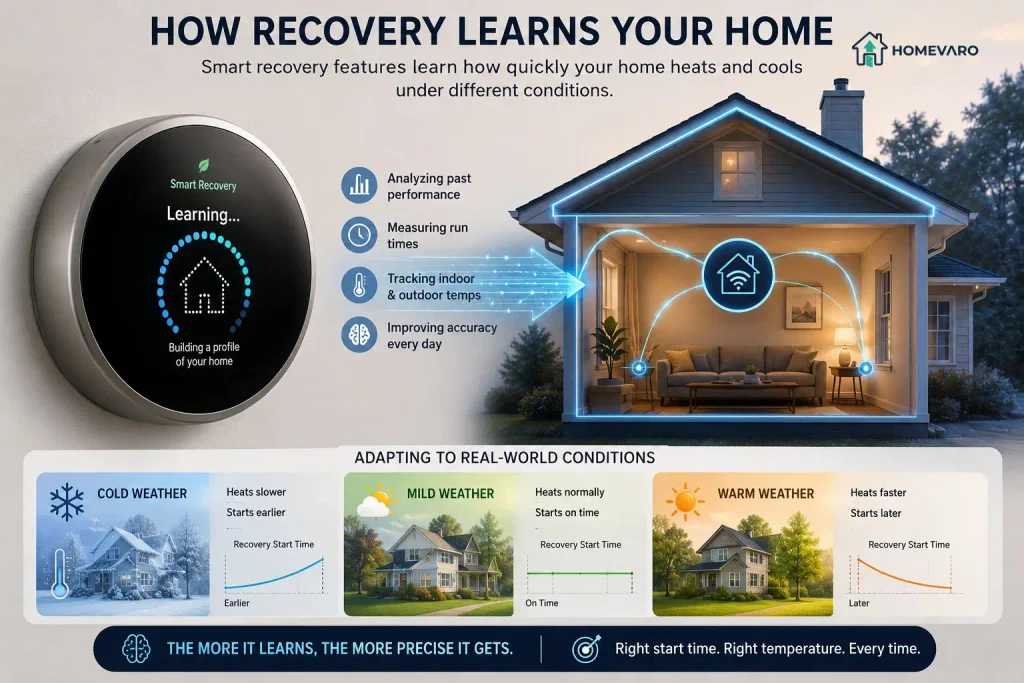
The thermostat does this by tracking how long your system takes to move the house a given number of degrees, then using that history to time the start. Colder outside temperatures, a bigger setback, or a slower system all push the start time earlier. That is why the exact same 6:30 a.m. wake setting can trigger the heat at 6:10 on a mild day and 5:35 on a cold one. The schedule did not change. The weather and the system’s own runtime did.
How the thermostat decides when to start
Most recovery features learn this over the first week or two of use, watching how long a cycle actually takes to close the gap between the setback temperature and the target. Some systems refine the estimate every single day, tightening the start time as conditions change through the season.
You do not have to configure the math yourself. The only thing worth confirming in your thermostat’s settings is that the feature is turned on, since it is sometimes labeled separately from the main schedule and can be toggled off by accident during setup.
The question that matters: does recovery cancel the setback savings?
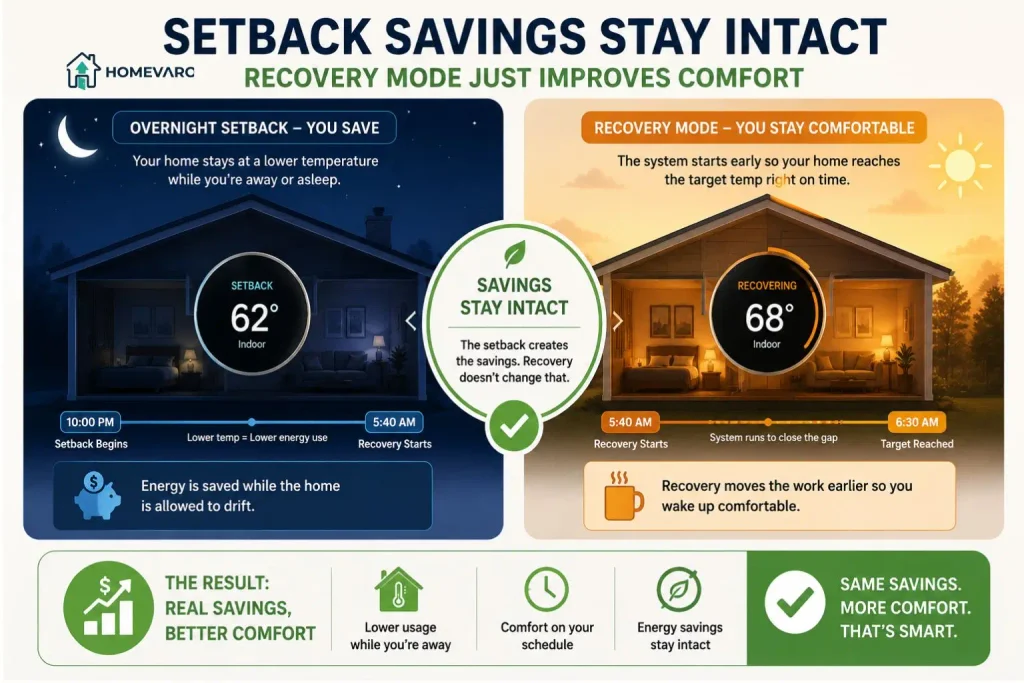
This is the actual worry, and the honest answer is no, not in the way it feels like it might. The savings from a setback do not come from the clock; they come from the total time the house spends at the lower (or higher) setpoint. Recovery only changes when the system starts closing that gap, not how wide the gap was while you were away or asleep.
The same mechanism explains why a temperature swing does not cost more than holding one number steady: the U.S. Department of Energy’s own guidance states that the energy it takes to reheat or recool a home is roughly equal to the energy saved while it was allowed to drift, so the net effect of the swing is a real gain, not a wash. Recovery simply moves the “closing the gap” work to a time that ends exactly when you need it, instead of leaving you to sit through it after you wake up.
A recovery period that runs for ten or fifteen minutes before your wake time is not eating your savings. It is spending a small, necessary slice of the recovered period on comfort so you never see the cold house that makes people abandon their setback altogether. If you want to see the full setpoint plan this sits inside, start with the copyable schedule template.
Signs recovery is running longer than it should
Recovery time is not fixed. It grows and shrinks with the weather, and that is normal. What is worth noticing is a trend, not a single morning:
- A recovery window that keeps stretching earlier across a season, from ten minutes in October to over an hour by January, on the same setback depth. That is a sign the system is working harder to close the same gap as it gets colder outside, the exact behavior described by a heat pump’s balance point, covered in detail here, where the system’s own capacity starts falling behind the house’s heat loss.
- Recovery that never seems to finish, where the house is still below target well past your scheduled time. That points to either an undersized setback margin for how cold your mornings actually get, or a system issue worth a technician’s look rather than a schedule tweak.
- Recovery on every single cycle, even mild days. If the feature always fires at the earliest possible time regardless of outdoor temperature, some thermostats are simply defaulting to a conservative estimate; check the manufacturer’s settings for a recalibration option before assuming something is wrong.
Recovery vs Geofencing vs a Fixed Schedule: How They Interact
Recovery is not a fourth mode competing with a schedule, geofencing, or learning mode. It runs underneath whichever one you use. A fixed schedule with recovery on gets you home to a warm house at a fixed time. Geofencing with recovery on tries to do the same thing based on when your phone signals you are heading back, which is why geofencing setups sometimes trigger recovery at an odd time if a phone’s location updates late. The full comparison of schedule, geofence, and learning modes is here if you have not settled on one yet.
What to do if recovery can’t keep up
If your house consistently is not at target by the time recovery should have finished, the fix is rarely a bigger setback swing. Start here instead:
- Narrow the setback a few degrees rather than widening it. A system that cannot recover from 10 degrees in the available time may recover comfortably from 6 or 7.
- Check the filter. A restricted filter slows every cycle, which quietly extends every recovery period on the schedule.
- If mornings are consistently cold even with recovery maxed out, that is a comfort complaint worth its own read. See the fix for a house that’s still cold when you get up.
Recovery is a feature designed to make setbacks invisible day to day. When it stops being invisible, that is useful information about the setback depth or the system, not a reason to give up on scheduling at all.
FAQ
Is recovery mode the same as adaptive recovery, smart recovery, or early start?
Yes. These are brand-specific names for the same underlying feature: the thermostat starting before the scheduled time so the target temperature is reached exactly when scheduled, rather than starting at the scheduled time itself.
Does recovery mode use more energy than just holding one temperature?
No source shows that it does, and the mechanism argues against it: recovery only changes when the “close the gap” work happens, not how much work there is to do. The gap itself is what the setback created, and that is where the savings live.
Can I turn recovery mode off?
Most thermostats allow it, but turning it off means the system starts exactly at your scheduled time instead of before it, so you will be waiting through the warm-up or cool-down period yourself. Leaving it on is what keeps a setback from feeling like a discomfort penalty.
Why does recovery start earlier in cold weather than in mild weather?
Because the thermostat is timing itself to your system’s actual heating or cooling rate under current conditions, and that rate slows as the outdoor temperature moves further from your target. The schedule you set never changes; only the lead time recovery needs to hit it does.