Emergency Heat vs Auxiliary Heat: What That Button Really Does
Most thermostats connected to a heat pump have an EM HEAT setting somewhere in the menu, separate from the auxiliary heat that runs automatically. The two names sound like variations on the same thing. They are not, and the difference matters enough that it is worth understanding before you ever touch that setting.
The one-sentence difference
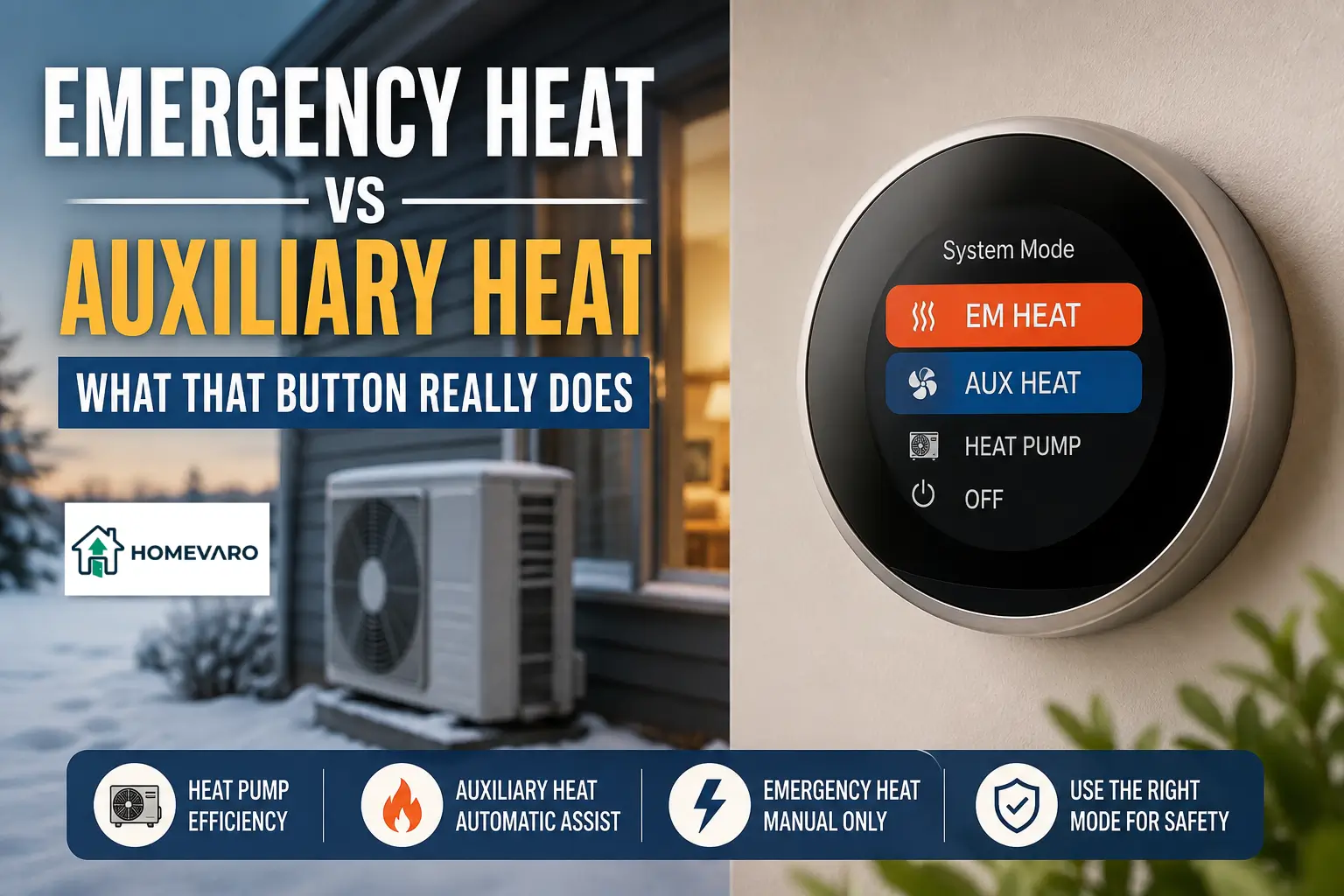
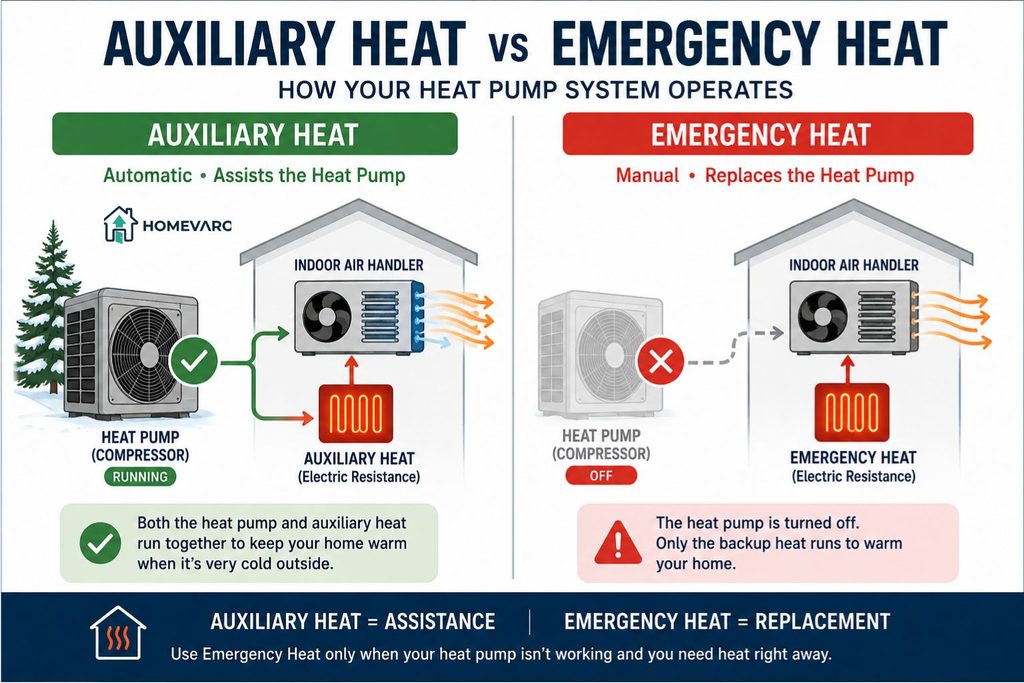
Auxiliary heat turns on by itself, automatically, running alongside your heat pump’s compressor to help it keep up. Emergency heat is switched on manually, by you, and it shuts the heat pump’s compressor off entirely, relying only on the backup heat source to warm the house.
Everything else in this article follows from that one distinction.
Auxiliary heat: automatic, and usually not a sign of trouble
Auxiliary heat is a normal, expected part of how many heat pump systems operate in cold weather. When outdoor temperatures drop far enough that the heat pump alone cannot keep up with the house’s heat loss, at or below what is called the system’s balance point, the thermostat automatically brings backup heat online to help, while the heat pump’s compressor keeps running too. The physical reason this happens is covered here, and the setting that controls exactly when it kicks in is covered here.
Seeing an “AUX” indicator light up on a genuinely cold morning is not, by itself, a problem. It is the system doing what it was designed to do.
Emergency heat: manual, and always a sign something is wrong
Emergency heat is a different mode entirely, and you have to switch it on yourself. Selecting it shuts off the heat pump’s compressor completely and runs the backup heat source alone, as if the heat pump were not part of the system at all.
This mode exists for one situation: the heat pump itself has stopped working, or you strongly suspect it has (unusual noises, ice buildup that will not clear, a complete failure to blow warm air), and you need the house to stay heated while you wait for a technician to look at it. It is not a setting for a cold morning, a system that seems to be running longer than usual, or a way to “boost” the heat faster. If your heat pump is working normally, emergency heat should never be the mode selected.
Why emergency heat costs so much, and why that’s the point
Both auxiliary and emergency heat typically rely on electric resistance heating, the same basic principle as an electric space heater or an oven element, which converts electricity directly into heat with none of the multiplying efficiency a heat pump’s compressor provides. HVAC-industry sources consistently describe this backup heat as costing several times more to run than the heat pump’s compressor alone, for the same amount of warmth, though the exact multiple depends on the specific system and local electricity rates.
That cost is not a flaw to work around. It is the reason emergency heat is meant to be temporary: it is an intentionally expensive bridge, built to keep a house warm for the days it takes to get a technician out, not a heating strategy to run indefinitely because it happens to be simpler than diagnosing the actual heat pump.
The stop line: this is a bridge, not a setting to leave on
If your heat pump has failed and you need heat while you wait for a repair, emergency heat is exactly the right tool, and using it is the correct call. What it is not is a setting to leave running because the compressor “seems to be working harder than it used to,” because you are unsure why aux heat keeps engaging, or because switching to EM HEAT made the house warm up faster on one occasion.
If you find yourself running emergency heat for more than a day or two, or repeatedly switching back to it, that is a heat pump that needs a licensed HVAC technician’s diagnosis, not a thermostat setting that needs adjusting. Nothing in this article is a substitute for that diagnosis, and no smart thermostat feature is designed to make emergency heat a safe long-term substitute for a working heat pump.
What to do instead of leaving emergency heat on
If you switched to emergency heat because something seemed off with your heat pump:
- Note what you observed before switching: unusual sounds, ice on the outdoor unit that would not clear, no warm air, or anything else that prompted the switch. This is exactly what a technician will ask about.
- Call a licensed HVAC technician to diagnose the heat pump itself. Emergency heat buys you time to make that call; it does not fix whatever caused you to need it.
- Switch back to normal heat pump operation once the technician confirms the system is repaired, rather than leaving emergency heat selected out of caution after the fact.
If what actually prompted your concern was aux heat running more often than expected on genuinely cold days, that is very likely normal system behavior, not a fault, and the lockout setting and balance point articles above are the right next read rather than the emergency heat setting.
FAQ
What is emergency heat on a thermostat?
It is a manually selected mode that shuts off the heat pump’s compressor entirely and runs the backup heat source alone. It exists for situations where the heat pump has failed or is strongly suspected to have failed, as a temporary way to keep the house heated until a technician can diagnose it.
Is it bad to run emergency heat all the time?
Yes. Emergency heat relies on electric resistance heat, which costs substantially more to run than a working heat pump’s compressor, and running it continuously means paying that premium for heat the compressor should be providing. If it is running for more than a day or two, the heat pump needs a technician’s attention, not a longer stay in emergency mode.
How do I know if I need to switch to emergency heat?
Signs the heat pump itself may have failed include unusual noises, a complete failure to produce warm air, or visible ice on the outdoor unit that does not clear during a normal defrost cycle. If you see these signs, switching to emergency heat to keep the house warm while you call a technician is a reasonable, correct step.
Will emergency heat damage my system if I leave it on?
Emergency heat itself is not typically what causes damage, but leaving it on for an extended period means an underlying heat pump problem is going undiagnosed and unrepaired, and whatever caused the switch in the first place is not being addressed. The cost risk is financial, from the higher operating expense, and the practical risk is a small heat pump issue going unaddressed long enough to become a larger one.