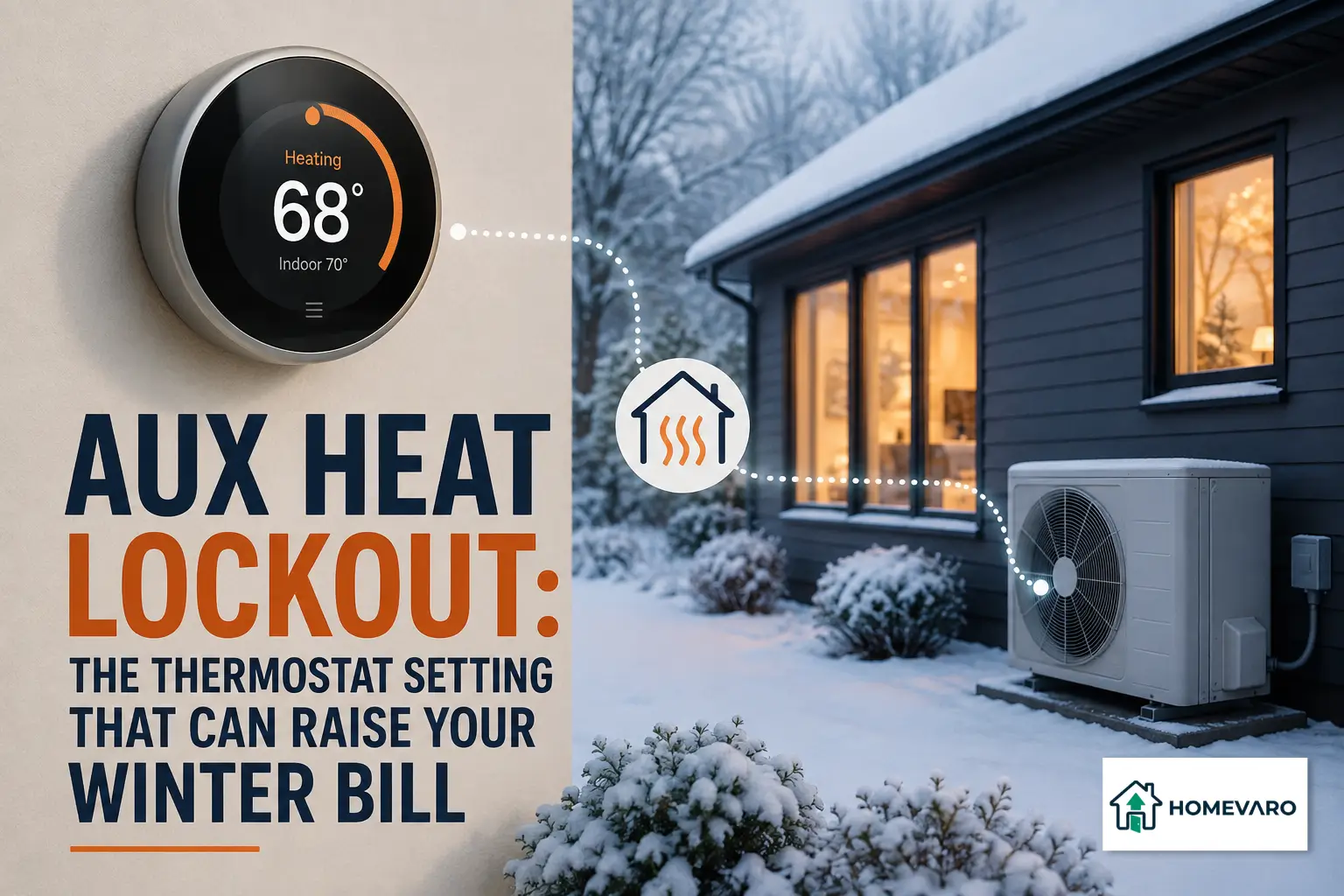
Auxiliary Heat Lockout: The Setting That Decides Your Winter Bill
If a heat pump home’s electric bill triples in January and nobody changed a single habit, the aux heat lockout setting is one of the first places to look. It is one thermostat setting, buried a few menus deep, and it quietly decides how often the most expensive way to heat your house turns on.
What the aux heat lockout setting actually controls
Most heat pump systems have a second heat source built in as backup, called auxiliary heat, supplemental heat, or aux heat. On the majority of residential systems this backup is electric resistance heat, essentially large heating elements, similar in principle to a space heater or an electric oven’s element, sized to heat the whole house.
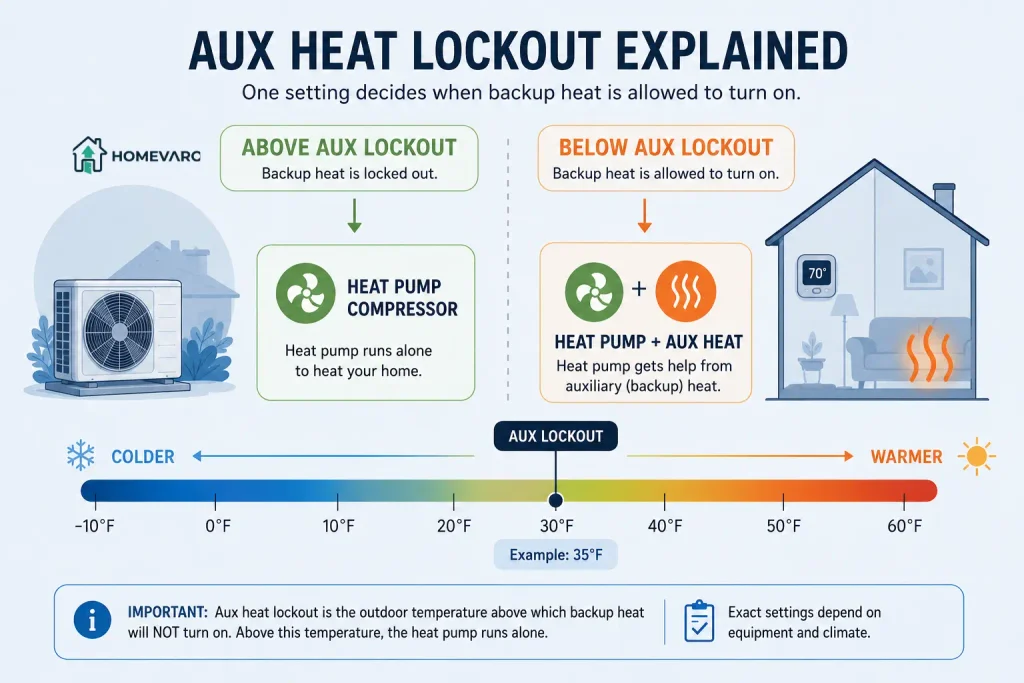
The aux heat lockout setting is the outdoor temperature above which that backup heat is not allowed to turn on at all. Above the lockout temperature, the thermostat relies on the heat pump’s compressor alone. Below it, the system is permitted to bring the backup heat online to help, or to take over entirely if the temperature drops far enough.
Set the lockout too high, and the backup heat starts kicking in on mornings that are not actually cold enough to need it. Set it appropriately, and the heat pump is given the chance to do the job by itself on all but the genuinely cold days.
Why aux heat costs so much more than the heat pump alone
A heat pump’s basic advantage is that it moves existing heat from outside air into the house rather than generating heat directly, which is why it can produce more heating energy than the electricity it consumes. Electric resistance heat does the opposite: it converts electricity directly into heat, one for one, with no multiplying effect.
HVAC-industry sources consistently describe backup resistance heat as costing several times more to run than the heat pump’s compressor alone for the same amount of warmth, though the exact multiple depends on the specific system, the outdoor temperature, and local electricity rates, so no single number applies to every home. What is consistent across sources is the direction: every hour the backup heat runs instead of the compressor alone is a materially more expensive hour, which is exactly why a lockout set too high, letting backup heat run more than necessary, shows up directly on the bill.
The commonly cited range, and why it isn’t one-size-fits-all
Energy Trust of Oregon’s own guidance describes aux heat lockout settings as vital to efficient operation of a heat pump system, and names a misconfigured lockout as a common, avoidable cause of unexpectedly high winter bills. Several HVAC-industry sources cite a starting point some manufacturers build into their default settings: an aux lockout around 35°F and a separate compressor lockout, the temperature below which the heat pump itself stops being relied on at all, around 5°F.
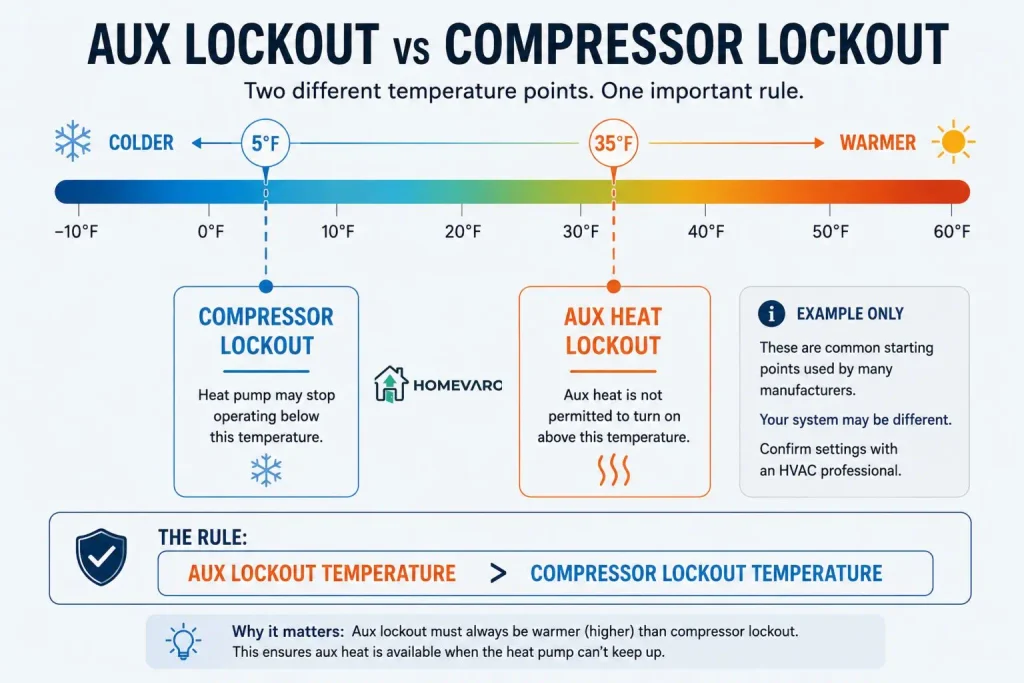
Treat that as a starting point to ask a technician about, not a number to copy into your own thermostat. The right lockout for your specific system depends on the heat pump’s actual capacity, your home’s insulation and size, and how cold your area typically gets. A system in a milder climate can often run the compressor safely to a lower outdoor temperature than a system in a genuinely cold one, which means a blanket 35°F recommendation may be unnecessarily conservative for one home and not conservative enough for another.
How to tell if your lockout is set too high
A few signs point toward a lockout that is starting backup heat earlier than it needs to:
- Your electricity use jumps sharply on days that are cold, but not the coldest of the season. If the aux heat only should be needed on the genuinely coldest days, but your usage spikes on an ordinary 30-degree morning, the lockout may be triggering it too soon.
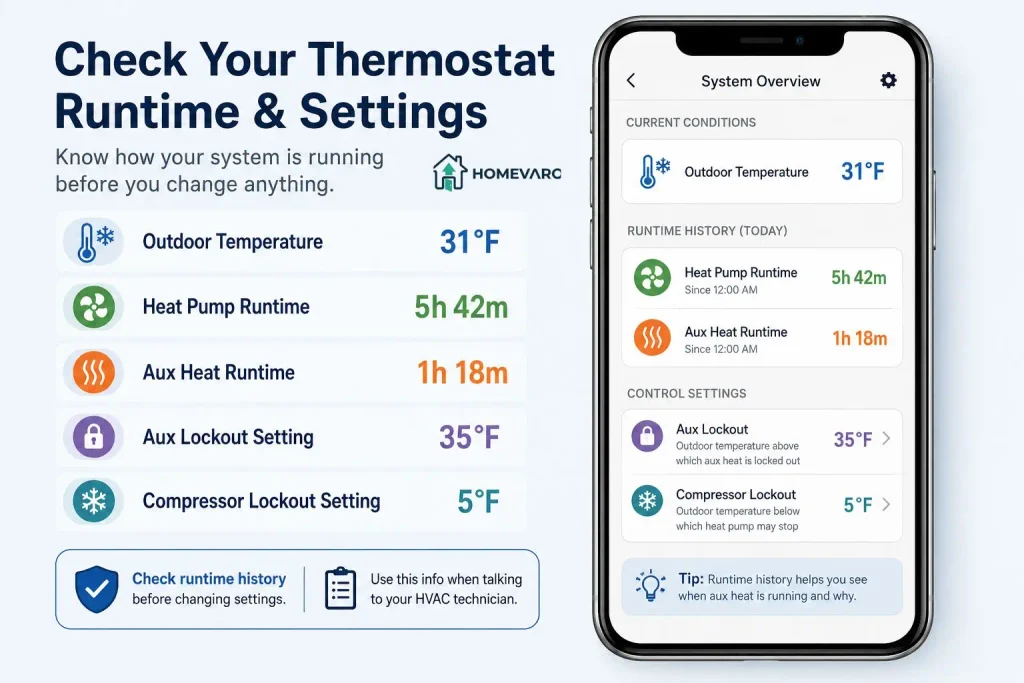
- The thermostat’s own history or runtime report shows aux heat running frequently at outdoor temperatures well above what your system’s specifications suggest it should need help at. Reading your own thermostat’s runtime history is covered in the pillar guide if you have not looked at that data yet.
- A recovery period that used to finish quickly now seems to trigger aux heat every time, which can also be a sign the lockout and the setback depth are interacting poorly, worth checking alongside the balance point your system was actually sized around.
The rule that must never be broken: aux lockout above compressor lockout
Whatever numbers a technician ultimately sets, the aux lockout temperature must sit above the compressor lockout temperature, never below it. The compressor lockout is the point at which the heat pump itself is considered too inefficient, or in some systems physically unable, to keep up, and the backup heat needs to be available at or below that point to keep the house heated. If the aux lockout were set below the compressor lockout, there would be a temperature band where neither source is available to help, which is not a setting anyone should be running with.
What to check yourself vs what to ask a technician
You can check your thermostat’s current aux lockout and compressor lockout settings yourself in most apps, usually under an installer or advanced-settings menu, and you can watch your own runtime history for the patterns above. What you should not do is guess at a new number and set it yourself without understanding your system’s specific capacity curve. This is a case where the right move is to bring your own usage pattern and your thermostat’s runtime data to an HVAC technician and ask them to confirm the lockout settings match your specific equipment and climate, rather than adopting a number from a forum or a different climate zone.
FAQ
What temperature should aux heat lockout be set to?
There is no single correct number for every home. Some manufacturers use roughly 35°F as a default starting point for aux lockout, and roughly 5°F for compressor lockout, per Energy Trust of Oregon and multiple HVAC-industry sources, but the right setting for a specific system depends on its capacity, your home, and your local climate. Confirm with an HVAC technician rather than copying a default.
Why does my heat pump keep running aux heat even when it isn’t that cold?
The most common cause is an aux lockout set higher than it needs to be for your specific system’s actual capacity, which allows the more expensive backup heat to activate on days the compressor alone could likely have handled. Check your thermostat’s runtime history for the outdoor temperature at which aux heat is engaging.
Can I set the aux lockout myself, or does it need a technician?
Most thermostats let you view and change the setting yourself, but choosing the right number requires knowing your specific heat pump’s actual output capacity at different outdoor temperatures, information a technician has and a homeowner generally does not. Bring your usage data to that conversation rather than guessing.
Is aux heat the same as emergency heat?
No. Aux heat runs automatically alongside the heat pump’s compressor when conditions call for extra help. Emergency heat is a separate, manually activated mode that shuts the heat pump off entirely and relies on backup heat alone, normally reserved for when the heat pump itself has failed. The full difference is covered here.