Why Deep Setbacks Backfire on a Heat Pump
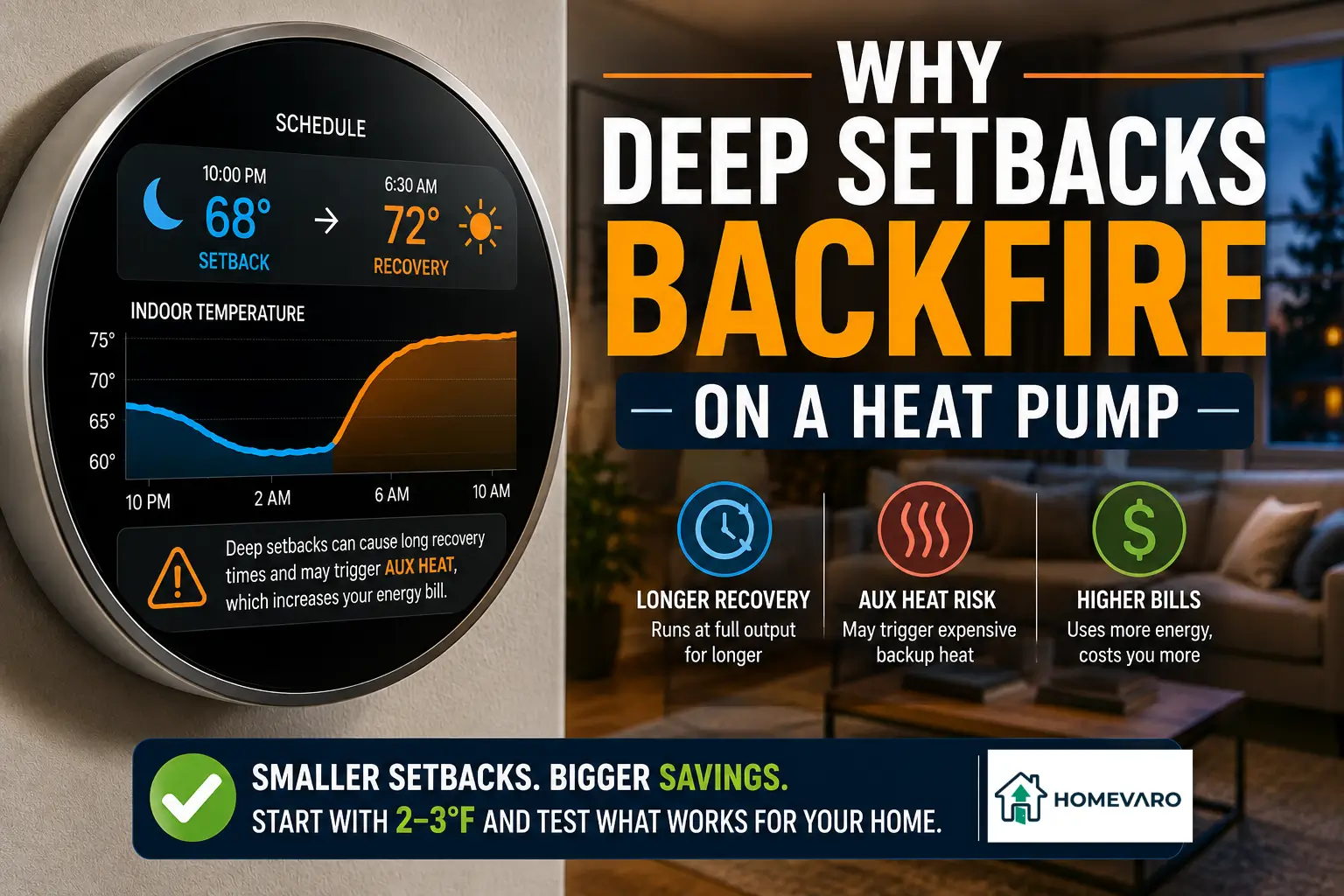
A heat pump running a deep overnight setback, the kind of 7- to 10-degree swing that a furnace handles without issue, can end up costing more than a smaller setback would, because recovering from that swing forces the heat pump into its least efficient mode and can pull in expensive backup heat to catch up. If you have a heat pump and your bill went up after you started setting the thermostat back at night, the setback itself is probably not the mistake. The depth of it might be.
Why a heat pump recovers differently than a furnace
A furnace has essentially one operating mode: on or off, burning fuel at a fixed rate. Setting a furnace back and letting it catch up later costs close to the same energy either way, which is the basis for the standard advice already covered on this site’s thermostat setup guide: turn it back 7 to 10 degrees while you are out or asleep, and recover on your normal schedule.
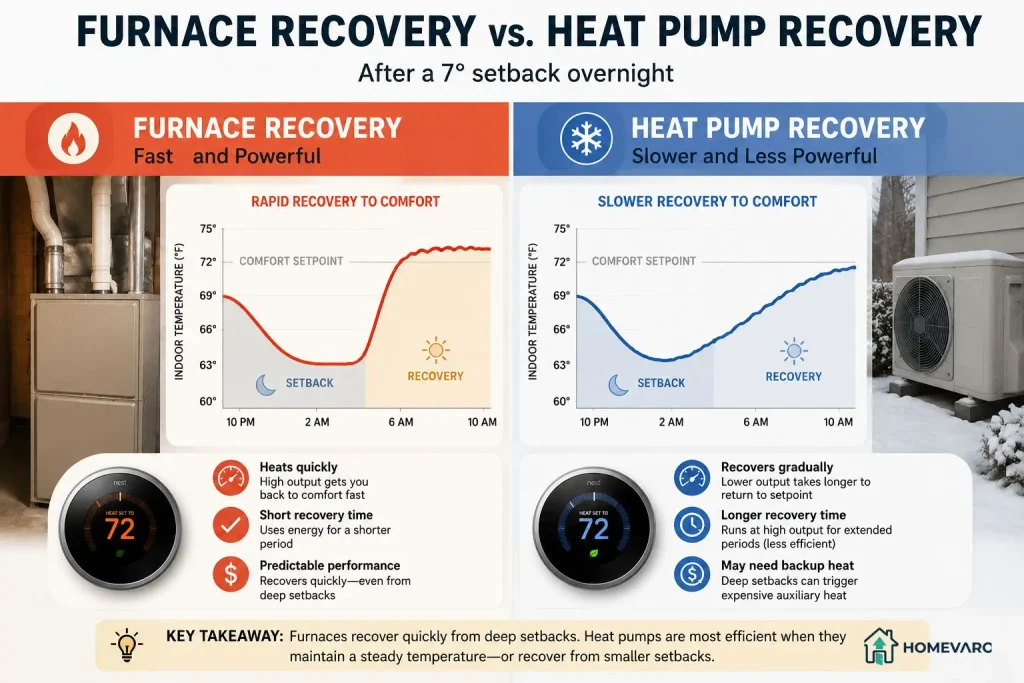
A heat pump is different. It moves heat rather than generating it, and modern heat pumps, especially variable-capacity models, are most efficient running at a low, steady output for long stretches, the way they do when simply holding a temperature. Recovering from a deep setback asks the system to do the opposite: run at full output for an extended period to reheat not just the air but the walls, floors and furniture that cooled overnight. Full output is the heat pump’s least efficient operating point.
What “full output” recovery actually costs
Running at full output for longer does not just use more energy in a simple, proportional way. A heat pump’s efficiency (its coefficient of performance) drops as it runs harder, so the last portion of a long recovery period delivers less heat per unit of electricity than the steady, low-output operation the system is designed around. The deeper the setback, the longer that inefficient recovery period runs.
This is the same mechanism, from the equipment’s side, that shows up on the thermostat as a long “catching up” period rather than a quick return to comfort.
When recovery pulls in the backup heat
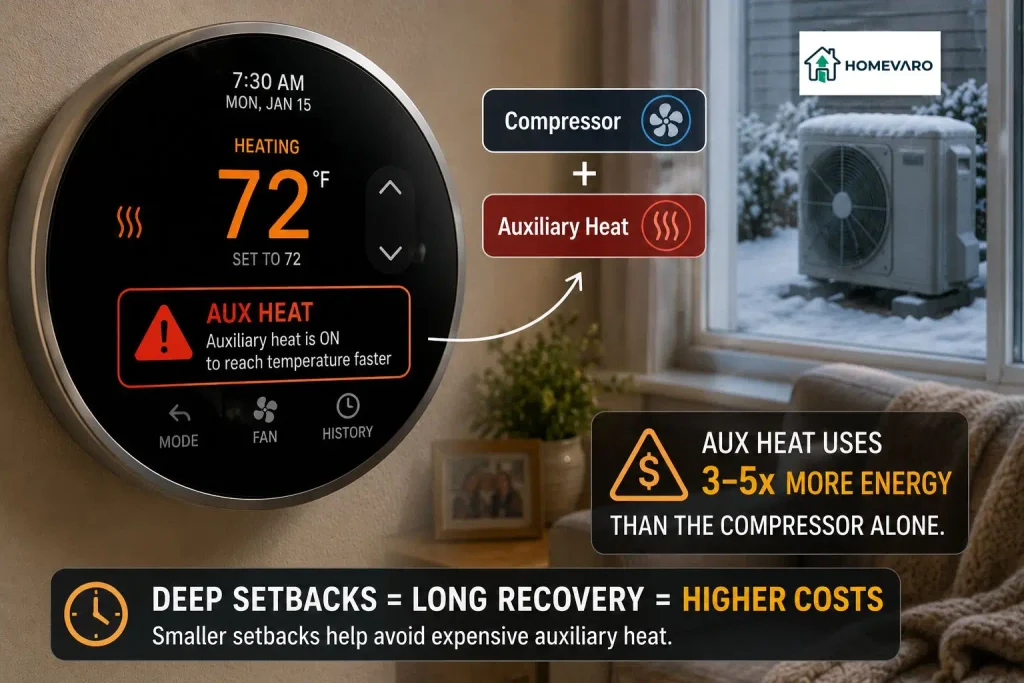
The bigger cost risk is what a long, demanding recovery can trigger: the electric-resistance backup heat covered in detail in this site’s guide to the aux heat lockout setting. If a thermostat’s recovery logic determines the compressor alone will not catch up fast enough, or if the outdoor temperature during recovery happens to sit below the system’s balance point, the backup heat can engage to help finish the job. Backup heat is several times more expensive to run than the compressor alone for the same amount of warmth, so a recovery period that pulls it in even briefly can erase the savings the setback was supposed to produce.
This is different from emergency heat, which is a separate, manually activated mode. This is the automatic backup heat helping out during a demanding recovery, which a homeowner may never see labeled on the screen but will see on the bill.
A revised setback range for heat pump households
The building-science and HVAC-contractor sources that discuss this specifically converge on a narrower range for heat pumps than the general DOE-style guidance:
| Setback depth | Typical outcome on a heat pump |
|---|---|
| 7 to 10 degrees (the general DOE-style guidance) | Recovery often runs at full output for an extended period and can pull in backup heat, especially over a shorter (6 to 12 hour) window |
| 2 to 3 degrees | Recovery stays closer to the system’s efficient operating range, avoiding the full-output period that erases the savings |
This is a directional recommendation drawn from multiple heat-pump-specific sources, not a single number that fits every system. A larger, longer setback (overnight while away for several days, for example) behaves differently than a short nightly one, and a system’s own capacity relative to the house matters. Treat the 2 to 3 degree range as the starting point to test, and watch your own runtime history and bill rather than assuming either number is exactly right for your home.
What this does and does not mean for your existing schedule
This does not mean setbacks are pointless on a heat pump. It means the depth matters more than it does on a furnace. A heat pump that holds one temperature all day still saves nothing over letting it run at a steady comfortable setting, the same point made on the pillar guide. The correction here is specifically about how deep to go, not whether to bother.
If your current schedule uses the general 7-10 degree range and your bill has climbed since you set it up, try narrowing the swing to 2 to 3 degrees for a full billing cycle and compare. If your thermostat has recovery mode reporting or a runtime history, watch specifically for whether backup heat is engaging during the recovery window, since that is the clearest sign a setback is too deep for your system.
FAQ
Does setting back a heat pump thermostat actually save money?
It can, but the standard 7 to 10 degree recommendation built for furnaces is often too deep for a heat pump. A shallower setback, in the 2 to 3 degree range, is more likely to save money without forcing an expensive, full-output recovery.
Why does my heat pump run aux heat after I raise the temperature back up?
A demanding recovery from a deep setback can exceed what the compressor alone can deliver quickly enough, which can trigger the backup resistance heat to help finish the job. That backup heat costs several times more to run than the compressor.
How many degrees should I set back a heat pump thermostat?
Multiple heat-pump-specific sources point to roughly 2 to 3 degrees as a safer starting range than the general 7 to 10 degree guidance, particularly for shorter setback windows. Treat this as a starting point to test against your own bill, not a fixed rule.
Should I just leave a heat pump thermostat at one temperature all day?
No. Holding one temperature constantly gives up the savings a setback provides. The fix for a heat pump is a shallower setback, not no setback at all.